
Regenerative Felling - Upper Roughdown
The Box Moor Trust is committed to responsible woodland management and works in close partnership with the Forestry Commission to ensure all activities follow best practice and national guidance.
Following thorough consultation and in alignment with Forestry Commission recommendations, we will begin regenerative tree felling works at Upper Roughdown in January 2026.
These essential works are being undertaken in response to the declining health of trees in this area. Proactive intervention is necessary to protect public safety and support the long-term health of the woodland ecosystem.
While these works will result in a noticeable transformation of the landscape, they are part of a broader strategy to regenerate and restore the woodland. Over time, this will encourage natural regeneration, improve biodiversity, and create a more resilient woodland for future generations.
Below we have outlined where and why the works are important. We appreciate the community’s understanding and support as we carry out these vital conservation efforts.
Where is Upper Roughdown?
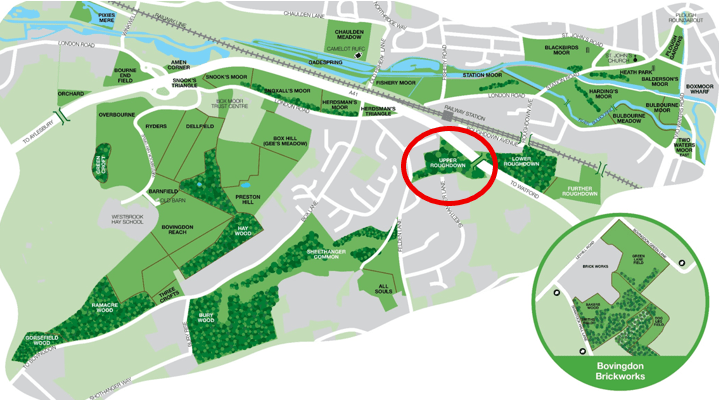
Upper Roughdown forms part of the larger Roughdown Common site, which comprises Upper, Lower and Further Roughdown.
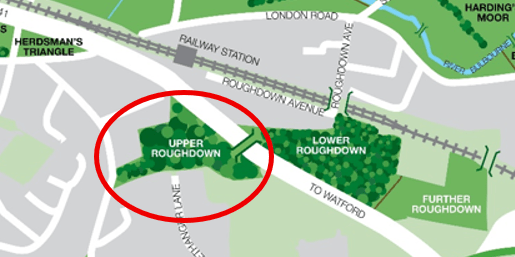
Upper Roughdown can be accessed from Felden Lane, Sheethanger lane or via Roughdown Avenue and following the route through Lower Roughdown and across the bridge over the A41.
Why is the health of the trees declining?
This area of broadleaved woodland contains a particularly high proportion of Ash trees, many of which are now showing signs of decline. You may have noticed the thinning canopy as you walk along the pathways — a visible symptom of the disease’s impact.
Ash Dieback weakens the structural integrity of affected trees, making them brittle and more prone to collapse. This presents a serious health and safety risk to anyone passing through, due to the increased likelihood of falling branches or entire trees.
Why are trees being removed in this area?
Upper Roughdown, as an open access woodland, is a popular area for walking and recreation. However, due to the increasing presence of Ash Dieback and the resulting decline in tree health, it has become necessary to carry out tree removal works.
These works are essential to ensure the area remains safe for public use. Diseased Ash trees can become brittle and unstable, posing a serious risk of falling branches or trees. By removing affected trees, we are proactively managing the woodland to protect visitors and maintain safe access for all.
In addition, this process forms part of a broader woodland management strategy aimed at promoting regeneration, biodiversity, and long-term sustainability of the site.
What is regenerative felling?
Regenerative felling is a sustainable woodland management practice that balances necessary tree removal with long-term ecological restoration. Rather than clear-cutting, this approach involves selective harvesting—removing diseased and/or overcrowded trees to create space and light for younger trees and natural regeneration.
Key objectives of the works include:
- Promoting natural regeneration of native species through seeding, coppicing, and targeted planting.
- Maintaining habitat diversity by preserving a mix of tree ages and species to support wildlife and ecological resilience.
- Minimising soil disturbance to protect the forest floor and encourage healthy regrowth.
- Ensuring public safety by removing structurally compromised trees at risk of falling.
We have been working closely with the Forestry Commission, and in line with their guidelines, the cleared area will be allowed to naturally regenerate for a period of two years. After this time, the site will be surveyed, and if necessary, we will carry out additional planting using a selection of native tree species to supplement naturally occurring growth. Our aim is to replace the same number of trees as felled, ensuring that future generations can enjoy a healthy and vibrant woodland.
These works form part of a broader woodland management strategy focused on biodiversity, sustainability, and long-term forest health. While the visual landscape of the woodland will undergo a noticeable transformation, the regenerative approach ensures that the area will recover and thrive over time.
How will this work affect public use of the area?
During the upcoming regenerative tree felling works at Upper Roughdown, visitors may experience some temporary disruption.
You may hear operational noise at times, particularly during the tree chipping phase. Our contractors will work within designated hours and aim to keep noise to a minimum. We will endeavour to ensure that chipping does not begin before 09:00.
The process will involve felling, chipping, and removing trees from the site. For safety reasons, it may be necessary to temporarily close access to certain footpaths and woodland areas. We kindly ask all visitors to follow signage, use alternative routes where provided, and avoid any cordoned-off zones.
If you have any questions or concerns please contact us using the button below. We may add your question to our FAQs.
Frequently asked Questions
As with all significant forestry operations, we hold a felling licence issued by the Forestry Authority. Our woodlands are regularly monitored, and we follow expert advice and guidance from the Forestry Authority—the governing body for forestry management and policy in England—on both proactive and reactive works. Following joint assessments, we have identified that our Ash trees are in decline, which is most evident in their thinning canopies and, in some cases, decaying stumps. If left untreated, these trees are highly likely to collapse—potentially within a year, though the exact timing is uncertain.
Because we cannot accurately determine how much structural integrity remains within these trees, it would be irresponsible to leave them standing in an open-access woodland with public rights of way. To safeguard our beneficiaries and the wider public, we must act now to mitigate this risk.
Consultation has been carried out via our website, also via a maildrop to residents locally that are directly implicated by the works. As a result of the consultation, an information walk Q&A was held in November.
Because of the danger involved removing the trees, it is necessary to use a Mobile Elevated Work Platform for the majority of the works. These will be vehicle mounted and a tracked type machine; damage to the understory will be kept to a minimum.
We are not clear-felling the woodland. Only diseased Ash trees, and any trees directly affected by their removal, will be taken out to ensure safety and stability.
This careful thinning will allow existing saplings to flourish, and within the first two years we expect many more young trees to establish naturally. The exact timeframe for full regeneration is difficult to predict, as different species grow at different rates and their success depends on local climate conditions.
The wood will be monitored over the next 2 years and then inspected by the Forestry Authority; any extra works will then be identified.
After consultation with the Forestry Authority, their advice was to not replant immediately; this would allow for natural regeneration of site resilient species. If after 2 years the coverage of trees within the area aren’t 1600 trees per Ha, then we would need to replant to have the required 1600 trees per Ha.
During consultation with the Forestry Authority, it was suggested to be a less invasive way of managing the ash trees and preserving other species within the woodland; this would build greater species resilience within the woodland.
If they are left in situ, limbs will fall at any time and eventually the whole tree will fall in a uncontrolled manner.
Over 60% of the trees within Trust woodlands are Ash. This is due in part to the chalky ground and the ash trees ability to spread seedlings rapidly.